Choosing the right home battery size is one of the most important decisions in a solar and storage install. Oversize it, and your payback stretches out. Undersize it and you miss savings, backup protection, or EV charging capacity.
In Australia, most homes land in the 10 to 15kWh battery range. That size covers typical evening usage for households consuming 15 to 25kWh per day and aligns well with 2026 battery rebates and virtual power plant programs.
This guide explains how to size a home battery step by step, using the same calculation logic installers use. It also shows when smaller systems make sense, when you should move into 15–20kWh territory, and how lithium and sodium-ion batteries change sizing decisions.
Why Home Battery Size Matters More Than Brand for Australian Households
Battery sizing directly affects three things:
- How much solar energy you can store instead of exporting
- How long your home stays powered during outages
- How quickly the system pays itself off
Most Australian households use around 15 to 20kWh of electricity per day. Roughly half of that is used in the evening and overnight, which is exactly what a home battery is designed to cover.
A correctly sized battery usually stores 40 to 60 % of daily usage, not 100 %. Chasing full coverage often adds cost without improving returns.
Home Battery Size Calculator Australia: Step-by-Step kWh Calculation
You can estimate the right battery size using a simple consumption-based method.
Step 1: List Evening and Overnight Appliance Loads in Australian Homes
Focus on appliances used after sunset.
Appliance
Power (W)
Hours Used
Energy (Wh)
Fridge
100
8
800
Lights
50
5
250
Television
150
4
600
Wi-Fi and devices
100
6
600
Total essentials (no EV)
2,650 Wh (2.65kWh)
Note: Realistic evening usage, including cooking and air conditioning, typically ranges from 8–10kWh. Electric vehicles are generally charged during the daytime from solar generation rather than evening battery discharge.
Step 2: Adjust for Usable Battery Capacity (Depth of Discharge)
Most modern batteries allow 85 to 90 % depth of discharge. To avoid over-sizing:
2.65kWh ÷ 0.9 = 2.94kWh usable required
Step 3: Add a 20–30 % Buffer for Degradation and Seasonal Use
Installers typically add a 20 to 30 % buffer to handle seasonal changes and degradation.
2.94kWh × 1.3 ≈ 3.8kWh
For this essential-load example, a 5–10 kWh battery system would be appropriate. However, most Australian households install 10kWh systems because realistic evening usage, including cooking, air conditioning, and other loads, typically reaches 8–10kWh.
Result
A 10kWh battery is the right size for most Australian households with typical evening consumption patterns.
This approach mirrors the logic used in popular Australian battery calculators and installer assessment tools.
Recommended Home Battery Sizes in Australia by Household and Daily kWh
Household Type
Daily Usage
Typical Battery Size
Notes
Small household (1–2 people)
10–15kWh
6–10kWh
Best for solar self-use
Average family
15–25kWh
10–15kWh
Covers most evening demand
Large home or EV owner
25–40kWh
15–25kWh
Supports EV charging
Backup-focused or off-grid
30kWh+
20kWh+
Requires inverter planning
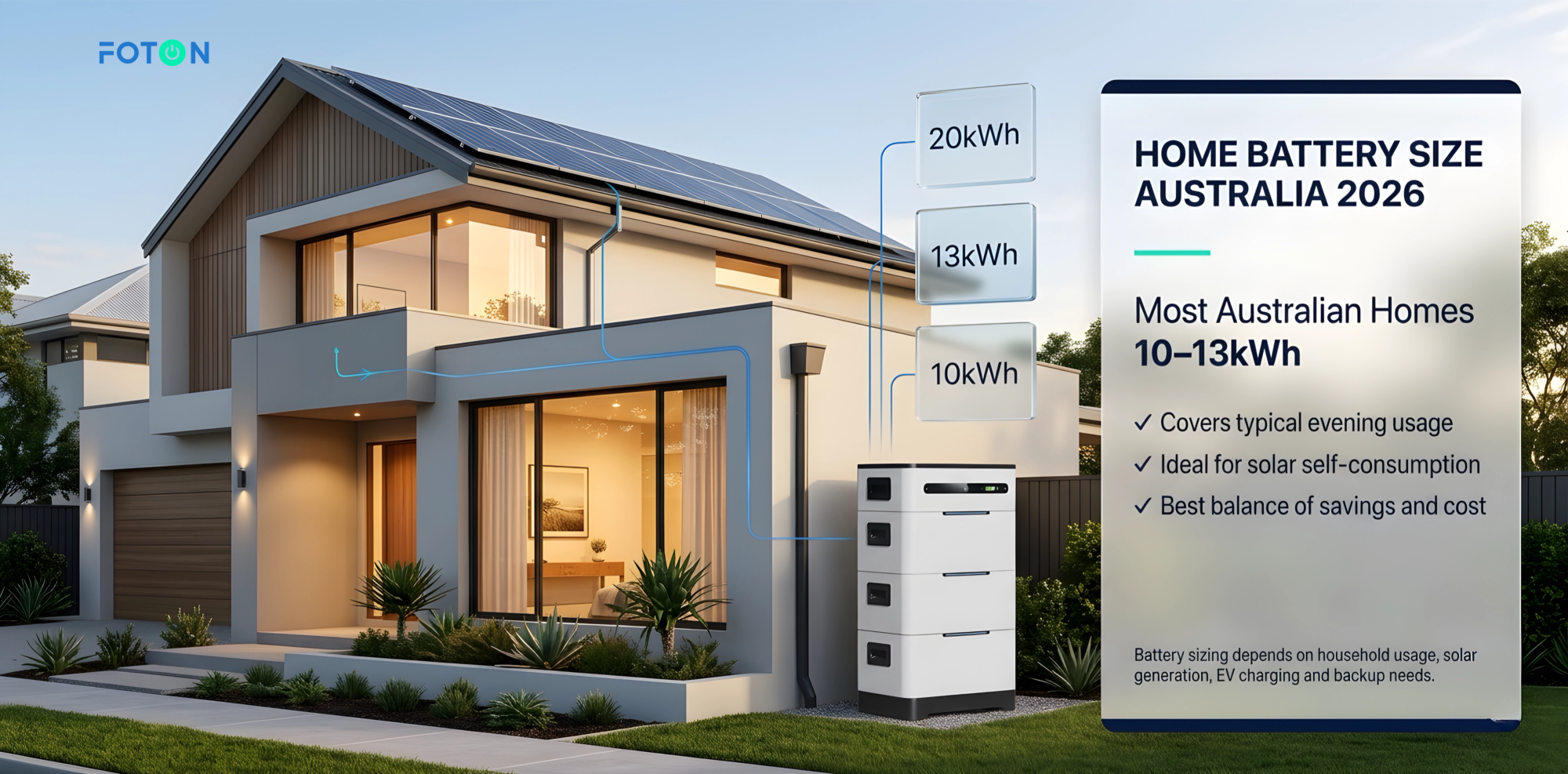
For most grid-connected homes, 10 to 13kWh delivers the best balance of savings and cost. Modular battery systems allow capacity to scale without replacing the full system.
How to Size a Home Battery for Solar Systems in Australia
If you already have solar, the battery size should roughly match your average daily excess generation.
- Small solar systems (5kW): 6–10kWh battery
- Medium solar systems (6.6kW): 10–13kWh battery
- Large solar systems (10kW+): 13–20kWh battery
Export limits and feed-in tariffs make storing excess solar more valuable than exporting it at low rates.
Home Battery Size for Backup Power During Australian Blackouts
Backup sizing depends on how long you want power during outages.
- Essentials only (fridge, lights, internet): 8–10kWh for 8–12 hours
- Essentials plus comfort loads: 13–15kWh for overnight backup
- Whole-home backup: 20kWh or more, often with load management
Backup-focused systems should also consider inverter output power, not just storage capacity.
Matching Battery Size to Inverter Power Output (kW)
Many battery sizing mistakes happen because homeowners focus only on storage capacity (kWh) and ignore inverter power (kW).
A battery can only deliver as much power as the inverter allows at any one time. For example, a 10kWh battery paired with a 5kW inverter can only run up to 5kW of appliances simultaneously, even if the battery is full.
Battery Size
Minimum Hybrid Inverter
Suitable Use Case
6–10kWh
5kW inverter
Standard evening loads
10–15kWh
5–8kW inverter
Backup plus light EV charging
15–25kWh
8–10kW inverter
EV charging and higher demand
For EV charging or whole-home backup, inverter power is often the limiting factor, not battery capacity.
What Battery Size Do You Need for EV Charging at Home in Australia
EV charging changes battery sizing quickly.
A single EV can add 8 to 15kWh of nightly demand. Homes charging from solar typically need at least a 15kWh battery, often paired with daytime charging strategies to maximize solar utilization.
Modular systems allow EV owners to start at 10–13kWh and add capacity later.
Battery Degradation and Chemistry Impact on Home Battery Size in Australia
Battery chemistry affects usable capacity, degradation rate, and long-term sizing accuracy.
Lithium iron phosphate batteries
Lithium iron phosphate batteries typically degrade by around 1 to 2 % per year. A 10kWh system installed today may deliver closer to 8kWh usable after 10 years. For this reason, lithium systems are often sized one step larger than current needs.
Sodium-ion batteries
Sodium-ion batteries degrade more slowly in high temperatures and maintain higher usable capacity over time. Most sodium-ion systems allow up to 90 % usable capacity and tolerate Australian heat more effectively.
In practical terms, a 10kWh sodium-ion battery can deliver similar usable energy to a larger lithium system in hot Australian conditions. This can slightly reduce the required system size for the same long-term outcome.
⚠️ Important Note on Federal Rebates: As of 2026, no sodium-ion batteries are currently Clean Energy Council-approved for the federal Cheaper Home Batteries Program. Only lithium-based systems qualify for federal rebates. Check the CEC-approved products list before purchasing if you require federal rebate eligibility.
Why Modular Home Battery Systems Are Better for Future Upgrades
Modular batteries allow homeowners to scale over time.
Common approach:
- Start with 10–13kWh
- Add modules when EVs, heat pumps, or higher tariffs arrive
This avoids paying for unused capacity upfront while preserving future flexibility.
Industry Standard Battery Sizes for Australian Homes
Drawing from comprehensive Australian usage data and installer expertise, here are the standard battery size recommendations:
- 10kWh systems for homes using 15–20kWh per day
- 13–15kWh systems for families with EV charging or higher evening loads
- 20kWh or more for VPP participation or partial off-grid setups
These sizing guidelines apply across all major battery brands available in Australia. Many systems offer modular options, allowing capacity to scale as household energy needs increase.
Battery Size Requirements for VPP and Grid Export Programs in Australia
Eligibility for rebates and grid programs is governed by the Cheaper Home Batteries Program, which sets minimum technical and compliance requirements for residential battery installations.
Virtual power plant programs often set minimum battery and inverter requirements.
Most Australian VPPs require:
- At least 10kWh of storage
- Minimum 5kW discharge capability
A 10–13kWh battery paired with a 5kW inverter is often the most efficient entry point for VPP participation without overspending on capacity.
Real Australian Household Usage Data That Informs Battery Sizing
According to AEMO household usage data, most Australian households consume around 16–20kWh per day, with evening usage accounting for roughly half of total demand.
This is why 10–13kWh batteries consistently deliver the best balance of savings, backup, and rebate efficiency for typical homes.
Common Home Battery Sizing Mistakes Australian Homeowners Make
- Choosing the largest battery available without usage data
- Ignoring inverter power limits
- Sizing for rare blackout scenarios only
- Not accounting for future EV or appliance loads
A good installer will review your interval data before finalising capacity.
FAQs About Home Battery Sizing
What battery size is best for an average Australian home?
For most Australian households using 16–20kWh of electricity per day, a 10–13kWh home battery provides the best balance of cost, savings, and backup. This typically covers around 50 % of evening and overnight usage.
What battery size do I need if my home uses 20kWh per day?
If your home uses around 20kWh per day, a 10kWh battery is usually sufficient for daily solar self-consumption. Homes seeking longer backup or EV charging should consider 13–15kWh.
What size battery is needed for EV charging at home?
Homes charging an electric vehicle overnight generally need at least a 15kWh battery paired with a 5–8kW hybrid inverter. This allows meaningful EV charging without draining the battery completely.
Is it better to oversize or undersize a home battery?
Oversizing a battery often increases payback time without adding real value. Undersizing limits savings and backup capability. The best approach is to size for 40–60 % of daily usage and choose a modular system that can expand later.
Do home battery size requirements change for VPP participation?
Yes. Most Australian virtual power plant programs require a minimum of 10kWh of battery storage and at least 5kW of discharge capacity. Systems below this threshold may not qualify for VPP incentives.
Next Steps: Get the Right Home Battery Size for Your Property
Use the tables and guidance above to estimate your ideal battery size. The next step is a personalised assessment based on your electricity usage, solar system, and goals.
Get multiple quotes from CEC-accredited installers to compare options and ensure competitive pricing. Installers can provide tailored recommendations, confirm rebate eligibility through the Clean Energy Regulator, and design a system that can scale with your needs.
For Foton Cospowers modular battery systems with flexible capacity scaling, visit www.foton.net.au